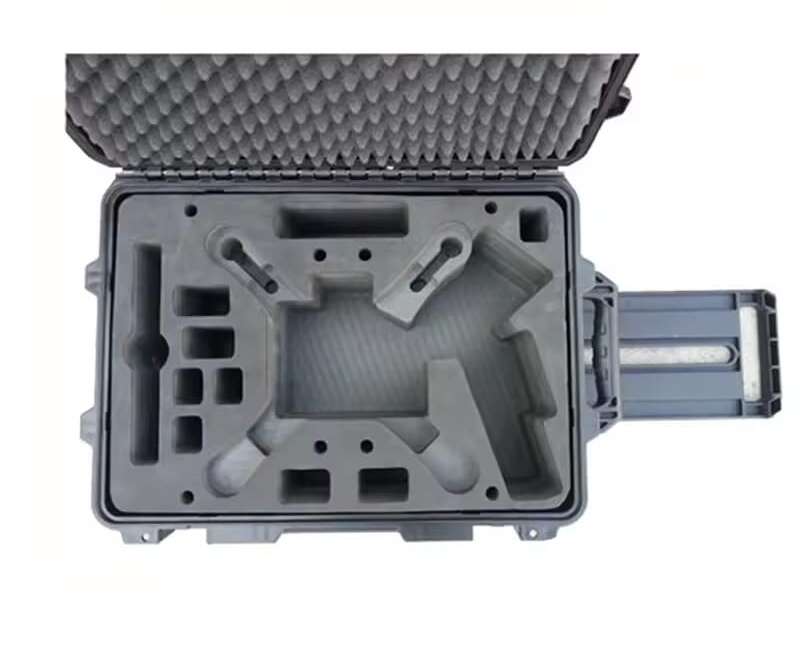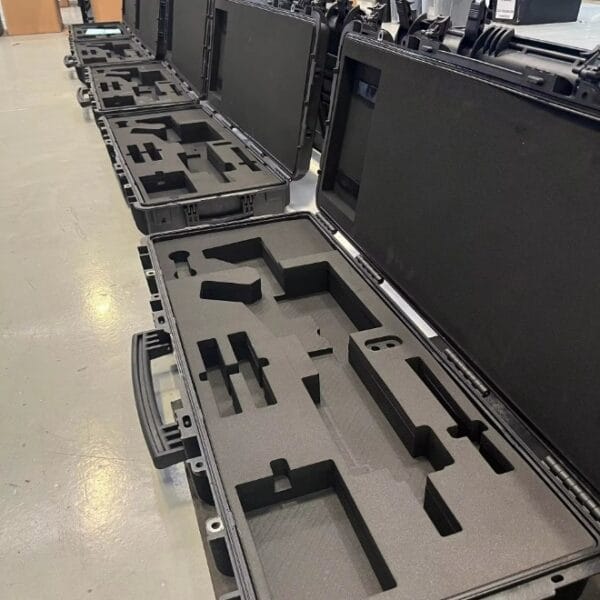

Guessing your packaging foam thickness is a major risk. If the foam is too thin, your product breaks. If it is too thick, your shipping costs skyrocket due to larger box dimensions. Finding the perfect foam thickness for packaging is a matter of basic logistics engineering. This guide explains how to calculate the exact cushioning depth required for transit.
To determine the ideal foam thickness for packaging, calculate the drop height of your shipping environment and the fragility rating (G-factor) of your product. Standard delicate electronics typically require a baseline of 2 inches of closed-cell foam (like Polyethylene or XLPE) for common 30-inch transit drops. Highly fragile items require 3 to 4 inches of foam to prevent bottoming out, while rugged industrial components can use 1 to 1.5 inches of high-density foam.
THE PHYSICS OF ACCELERATION AND PACKAGING DEPTH
When a shipping box falls, it stops instantly upon hitting the ground. The product inside, however, continues to move. The packaging foam acts as a braking system. The thickness of the foam determines the physical distance your product has to slow down.
If you use 2 inches of foam, your product has exactly 2 inches of space to come to a safe stop. If the foam is too thin, the product will compress the foam completely and hit the outer box wall. This is called bottoming out, and it transfers the destructive impact force directly into your item.
DROPS AND FRAGILITY RATINGS
To measure required thickness, you need two pieces of data: Drop Height and G-Factor.
Drop Height represents the realistic hazard of your shipping channel. For parcel couriers handling boxes under 20 pounds, the industry standard is a 30-inch drop height. For palletized heavy machinery handled by forklifts, the drop height baseline decreases to 18 or 24 inches.
The G-Factor is your product’s fragility rating, measuring the maximum shock it can survive before breaking. One G equals the force of gravity. Extremely fragile items (like telescope lenses or lab scales) have a low rating of 15 to 25 Gs. They require thick foam. Moderately fragile items (like computer servers or camera lenses) fall between 40 and 60 Gs. Rugged industrial parts can withstand 100 Gs or more.
HOW TO CALCULATE STATIC STRESS
You cannot choose a thickness without knowing the weight distribution. You must calculate Static Stress, which is the pressure the item puts on the foam.
The formula is: Static Stress equals Weight divided by Surface Area.
For example, if a device weighs 30 pounds and its bottom surface area touching the foam is 60 square inches, you divide 30 by 60. This gives you a static stress of 0.5 pounds per square inch (PSI).
Packaging engineers map this PSI number against a manufacturer’s Cushion Curve chart. This chart tells you exactly how many inches of foam are required at 0.5 PSI to keep the impact shock below your product’s specific G-factor.
QUICK SELECTION PROTOCOL
For standard parcel transit with a 30-inch drop height, use these baseline rules: For high fragility (under 25 Gs), use 3 to 4 inches of foam thickness. For moderate fragility (25 to 60 Gs), use 2 inches of foam thickness. For low fragility (above 60 Gs), use 1 to 1.5 inches of foam thickness.
Material type also affects thickness. Soft, open-cell Polyurethane foam compresses easily, meaning you need a greater thickness to prevent bottoming out. Stiff, closed-cell foams like Polyethylene (PE) and Cross-Linked Polyethylene (XLPE) absorb more energy per inch. This allows you to use thinner foam layers, which keeps your overall box dimensions smaller.
THE DANGERS OF PACKAGING GUESSWORK
Using the wrong thickness harms your bottom line in two ways.
Under-cushioning destroys your product. The cost of product replacement, return logistics, and damaged client trust far outweighs the cost of proper packaging design.
Over-cushioning destroys your shipping budget. If you add unnecessary inches of foam to every side of a product, your shipping box grows significantly. Carriers charge based on dimensional weight (the volume of the box). Over-cushioning can double your monthly freight expenses while providing zero additional protection.
CONCLUSION
Measuring the right foam thickness for packaging balances safety with financial efficiency. A standard 2-inch thickness of high-quality XLPE or PE foam serves as the ideal benchmark for most professional equipment. By calculating your item’s static stress and drop risks, you can optimize your packaging, reduce shipping costs, and eliminate transit damage permanently.