
What is the ROI of Custom Foam Packaging?
The ROI (Return on Investment) of custom foam packaging is calculated by subtracting the total cost of damaged goods, reverse logistics, and lost labor from the initial investment in engineered foam. For B2B companies, custom foam typically pays for itself by reducing the “Damage Rate” from a standard 3–5% to less than 0.5%, while simultaneously cutting packing labor time by up to 70%.
In the B2B world, shipping damage is often treated as an inevitable “cost of doing business.” But for companies moving high-value industrial components, medical lasers, or aerospace parts, that “inevitability” is a silent profit killer.
When a product arrives broken, the loss isn’t just the manufacturing cost of the item. It’s a cascading failure of logistics, labor, and customer trust. Transitioning from generic packing materials like bubble wrap or “peanuts” to engineered custom foam isn’t an aesthetic choice it’s a high-yield financial strategy.
1. The “Damage Iceberg”: Hidden Costs of Poor Packaging
Most procurement managers look only at the unit price of the item when calculating loss. In reality, the visible replacement cost is just the tip of the iceberg.
- Reverse Logistics: Shipping a broken 50lb industrial pump back to the factory often costs double the original outbound freight.
- Administrative Friction: The hours spent by customer service, accounting (processing credits), and warehouse staff (receiving returns) are “soft costs” that drain thousands from the bottom line annually.
- Production Delays: In B2B, your product is often a “missing link” in your customer’s assembly line. If it arrives broken, you aren’t just replacing a part; you are responsible for their downtime, which can lead to hefty contract penalties or lost future bids.
- Brand Equity: Reliability is the primary currency of B2B relationships. If your packaging looks “amateur,” your engineering is perceived as amateur.
2. Speed as a Profit Center: Labor ROI
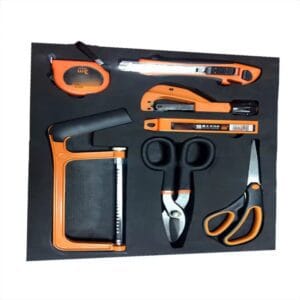
If it takes a warehouse worker three minutes to wrap an item in layers of bubble wrap and tape, and only 15 seconds to “drop and click” that same item into a custom Foamkart insert, the math becomes undeniable.
Efficiency Comparison
Metric | Generic Packaging (Bubble/Peanuts) | Custom CNC Foam Inserts |
Packing Time | 2–5 minutes per unit | 10–20 seconds per unit |
Training Required | High (Consistency is hard to teach) | Zero (The foam dictates the placement) |
Material Waste | High (Over-wrapping is common) | Zero (Exact fit every time) |
Protection Level | Variable (Human error prone) | Engineered (Repeatable G-force protection) |
In high-volume operations, saving 2 minutes per box across 5,000 shipments a year saves 166 man-hours. That is a full month of one employee’s salary reclaimed simply by changing the foam.
3. Engineering Out the Human Element
The greatest risk in shipping isn’t the courier; it’s the variability of the packer. On a Friday afternoon, a tired employee might use three wraps of bubble wrap instead of the required six.
Custom foam removes the “human guess-work.” Because the cavity is CNC-machined to the exact dimensions of the product, it can only be packed one way—the right way. This standardization ensures that the 1,000th unit shipped has the exact same shock-absorption profile as the first.
4. Sustainability and the “Reusability” Factor
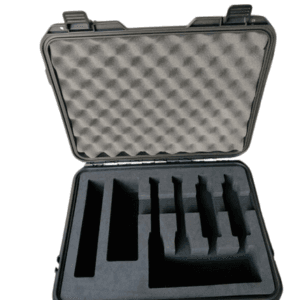
In B2B “closed-loop” logistics (where items move between a factory and a service center), custom foam inserts in plastic flight cases offer a massive ROI boost through reusability.
- Single-Use vs. Multi-Year: Cardboard and bubble wrap are trashed upon arrival. A high-density XLPE foam insert can survive 5–10 years of daily use.
- Waste Reduction: Reducing the “volumetric weight” of a package by using precisely sized foam instead of oversized boxes filled with air-pillows can reduce freight costs by 10–15% over time.
The “Break-Even” Calculation
To see if custom foam makes sense for your business, run this simple audit:
- Total Units Shipped per Year x Current Damage Rate % = Units Lost.
- Units Lost x (Unit Cost + $150 average for reverse logistics/labor) = Your Annual Leakage.
- Cost of Custom Foam – Cost of Generic Materials = Investment.
If your “Annual Leakage” is higher than your “Investment,” you are currently losing money by not using custom foam. For most B2B companies dealing with items valued over $200, the break-even point occurs within the first 100 shipments.
Pro Tip: When presenting this to a CFO, don’t talk about “better padding.” Talk about “Customer Churn Mitigation” and “Logistics Labor Optimization.” Those are the metrics that drive the decision to upgrade.