
To prevent product damage during transit, a reactive “more padding is better” approach is often the most expensive and least effective strategy. Professional transit protection requires a shift toward predictive engineering, where the chemical properties of materials like Cross-Linked Polyethylene (XLPE) are matched to the physics of kinetic energy.
This in-depth guide explores how to leverage XLPE foam to eliminate shipping damage, reduce returns, and optimize your logistics ROI.
In the global supply chain, a package is rarely “handled with care.” From the 42-inch drops in automated sorting centers to the high-frequency vibrations of a long-haul semi-truck, your product is subjected to a constant barrage of mechanical stress.
The goal of professional packaging isn’t just to “wrap” an item; it is to manage deceleration. When a box hits the ground, it stops instantly, but the product inside continues to move. If that movement isn’t slowed down gradually, the resulting G-force will shatter components. XLPE foam is the premier tool for this task.
1. The Physics of Protection: Fragility and G-Force
Before you select a foam, you must understand the Fragility Factor (G or Gf) of your product. This is a measure of the maximum acceleration an item can withstand before it breaks.
Fragility Categories by Industry
Fragility Level | Peak G-Force Limit | Typical Products |
Extremely Fragile | 15–25 G | Precision optics, satellite sensors, glass art. |
Very Delicate | 25–40 G | High-end medical monitors, laboratory scales. |
Delicate | 40–60 G | Computer servers, cinematography lenses, 3D printers. |
Moderately Rugged | 60–115 G | Industrial pumps, hand tools, standard electronics. |
Rugged | 115+ G | Cast-iron engine parts, heavy fasteners, solid steel. |
The XLPE Mission: The function of an XLPE insert is to extend the time of impact. By compressing, the foam acts as a “braking system,” ensuring the peak deceleration never exceeds the product’s G limit.
2. Material Deep-Dive: Why XLPE for Transit?
While standard Polyethylene (PE) or Polyurethane (PU) foams are common, Cross-Linked Polyethylene (XLPE) is the gold standard for high-value transit.
Molecular Superiority
The “Cross-Linking” process creates permanent chemical bonds between polymer chains.
- Zero Compression Set: Unlike cheaper foams that “take a set” (stay flattened after a heavy weight is applied), XLPE has 99% memory. This is vital for long-haul shipping where an item might sit in the same position for weeks.
- Non-Abrasive “Fine Cell” Structure: XLPE has microscopic cells. This results in a smooth surface that won’t “burnish” or scratch Class-A surfaces like polished aluminum or touchscreens.
- Hydrophobicity: XLPE does not absorb moisture. In damp shipping containers or sea freight, standard foam can trap humidity against a metal product, leading to “transit rust.” XLPE acts as a moisture barrier.
3. The Math of Transit: Calculating Static Stress
To select the correct thickness and density of XLPE, you must calculate Static Stress (S). This determines if the foam is strong enough to support the weight or if it will “bottom out” during a drop.
The Formula
S = \frac{W}{A}
- W: Total weight of the product (lbs).
- A: Surface area of the foam in contact with the product (sq. in).
Example: Shipping a 40lb Medical Device
If the device rests on a foam base that is 10″ x 10″, the surface area is 100 sq. in.
S = \frac{40}{100} = 0.4 \text{ PSI}
How to Use This Result:
Every XLPE density has a Cushion Curve. If your calculated Static Stress (S) is 0.4 PSI, you would look at the curve for 2.0lb XLPE. If the curve shows that 2.0lb foam at 0.4 PSI results in 35 Gs of force, and your product can handle 50 Gs, you have a safe, engineered design.
4. Designing for the “Drop”: Thickness and Density
A common mistake is using foam that is too “hard” for a light product. This is called Over-Cushioning. If the foam is too dense, it won’t compress at all during a drop, transferring 100% of the shock directly to the product.
The Foamkart Selection Matrix
- Lighter Products (<10 lbs): Benefit from lower-density XLPE (1.5lb to 2.0lb) to allow for sufficient compression.
- Heavy Products (>50 lbs): Require high-density XLPE (4.0lb to 6.0lb) to prevent the part from “piercing” through the foam layer on impact.
- Thickness Rule of Thumb: For most “Delicate” items, a minimum of 2 inches of foam on all six sides is the baseline for a 30-inch drop.
5. Vibration Dampening: The Silent Damage
Impact (drops) breaks things instantly, but vibration (truck hum) breaks things over time. This is called “Mechanical Fatigue.”
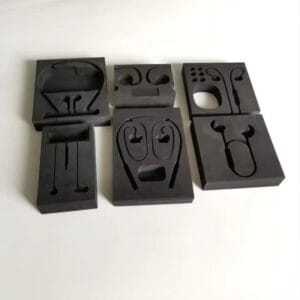
Standard “pick-and-pluck” foam often has gaps that allow a product to rattle. CNC-machined XLPE creates a friction fit. Because the foam is cut to the exact 3D contour of the item, there is zero air gap. This “Total Surface Contact” dampens high-frequency vibrations that otherwise cause:
- Fastener Loosening: Screws backing out of internal circuit boards.
- Relay Failure: Delicate mechanical switches being “chattered” into failure.
- Lens Creep: In optics, internal glass elements shifting off-center.
6. Advanced Design Strategies: Beyond the Box
When engineering for high-risk transit, we move beyond simple “padding” and into Structural Design.
Strategy A: The “Cradle” (Encapsulation)
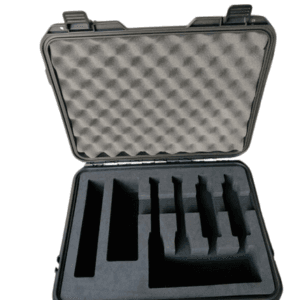
The product is sandwiched between two custom-routed XLPE halves. This ensures that no matter how the box is oriented, the center of gravity is perfectly balanced.
Strategy B: Corner Blocking
For massive industrial equipment, filling a crate with foam is too expensive. Instead, we use high-density (6lb+) XLPE Corner Blocks. This concentrates the protection on the eight most likely points of impact, significantly reducing material costs while maintaining a high safety rating.
Strategy C: The “Floating” Base
For items with delicate tops but heavy bottoms (like a lab centrifuge), the weight is supported by a thick XLPE base, while the top is secured by a softer “lid” foam. This prevents the heavy base from crushing the delicate top during a “tumble” event.
7. The Financial Impact: Measuring Your ROI
If you ship 1,000 units a month and have a 3% damage rate, you are losing 30 units. If each unit is worth $500, that is $15,000 per month in lost inventory, plus the “hidden” costs of reverse logistics and customer dissatisfaction.
Transitioning to Custom XLPE:
- Upfront Cost: $10–$15 more per box than generic padding.
- Damage Reduction: Typically drops from 3% to under 0.2%.
- Monthly Savings: $14,000+.
- Labor Savings: Custom inserts can be “dropped in” by staff in seconds, whereas bubble-wrapping takes minutes. In a high-volume warehouse, this often saves 1–2 full-time salaries.
Summary Checklist: Are You Protected?
Before you hit “ship,” verify these five points:
- Static Stress: Does your weight/surface area ratio match your foam density?
- Z-Axis Support: Is the product supported in the center, or just at the edges?
- Chemical Inertness: Will the foam out-gas and damage your product’s finish? (XLPE is inert).
- Drop Height Verification: Is the foam thick enough for a 36-inch or 42-inch drop?
- Moisture Control: Are you using closed-cell foam to prevent humidity damage?
Conclusion: Engineering a Damage-Free Future
Preventing transit damage is a matter of removing the “human variable” from the packing process and replacing it with material science. By utilizing the high-performance properties of XLPE and the precision of CNC routing, you ensure that the quality of your product at delivery matches the quality it had at the factory.