
Why is XLPE used in Medical Packaging?
XLPE (Cross-Linked Polyethylene) is a high-purity, closed-cell foam preferred for medical applications because it is chemically inert, non-toxic, and resistant to moisture and bacteria. Unlike standard polyethylene, the cross-linking process creates a more stable molecular structure that prevents “outgassing” and ensures zero particulate shedding—making it fully compliant with ISO cleanroom standards.
Medical-Grade XLPE Foam: Ensuring Cleanroom Compliance and Device Integrity
In the medical and life sciences sectors, the difference between a successful product launch and a costly recall often comes down to what happens inside the box. When transporting a $100,000 surgical laser or a delicate set of diagnostic reagents, the packaging isn’t just “padding” it is a critical component of the device’s sterile barrier and functional integrity.
For laboratory and medical environments, standard foams fall short. They flake, they off-gas, and they absorb moisture. This is why Cross-Linked Polyethylene (XLPE) has emerged as the industry gold standard.
The Science of “Clean”: Beyond the Surface
To understand why XLPE is mandatory for labs, we have to look at its molecular architecture. Standard polyethylene foam is like a bundle of loose straws; XLPE is like a reinforced, welded grid.
1. Zero Particulate Shedding (ISO Compliance)
In a Class 100 (ISO 5) cleanroom, a single airborne fiber can ruin a semiconductor or contaminate a biological sample. Traditional “Pick-and-Pluck” or open-cell foams are prone to “friability”—the tendency to break down into tiny dust particles over time.
Foamkart’s XLPE is nitrogen-blown, meaning no chemical blowing agents are used that could later leach out. The result is a smooth, skin-like surface that stays intact even after thousands of uses, ensuring your cleanroom stays clean.
2. Moisture Resistance and Hydrophobicity
Bacteria love moisture. In a clinical setting, any material that “wicks” fluid is a biohazard. Because XLPE is closed-cell, the individual cells are completely sealed off from one another.
- Absorption Rate: Effectively 0%.
- Vapor Barrier: It acts as a natural gasket, preventing humidity from reaching sensitive electronic contacts or reagents.
- Wash-Down Capability: You can sanitize XLPE inserts with Isopropyl Alcohol (IPA) or bleach solutions without the foam absorbing the chemical or degrading.
Technical Comparison: XLPE vs. Standard Polyethylene
Property | Standard PE Foam | Medical-Grade XLPE |
Cell Structure | Open or semi-closed | 100% Closed-cell |
Outgassing | High (Chemical blowing agents) | Near-Zero (Nitrogen-blown) |
Chemical Resistance | Moderate | High (Resists oils, acids, alcohols) |
Texture | Rough/Abrasive | Soft/Non-abrasive (Class A surfaces) |
Cleanroom Use | Not Recommended | Approved (ISO 5 – ISO 8) |
Engineering for Fragility: The “Cradle” Effect
Medical devices often involve “Class A” surfaces—highly polished metals or optics that can be scratched by even the slightest friction.
Protecting Optics and Lasers
Diagnostic equipment often relies on precisely calibrated mirrors and lenses. If a foam insert is too stiff, it transfers vibration (G-force) directly to the device. If it’s too soft, the device “bottoms out” against the hard outer case. Foamkart engineers use static load calculations to determine the exact density of XLPE needed to suspend the device in a “neutral zone,” absorbing 95% of transit vibrations.
Custom Kitting for Surgical Sets
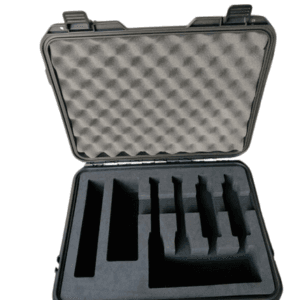
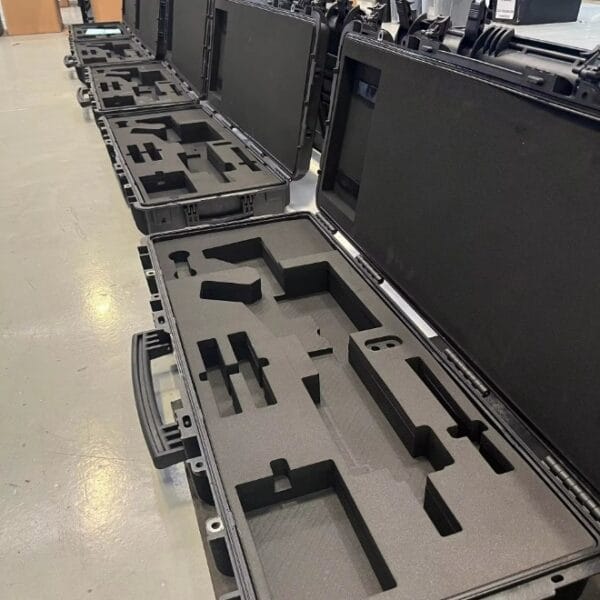
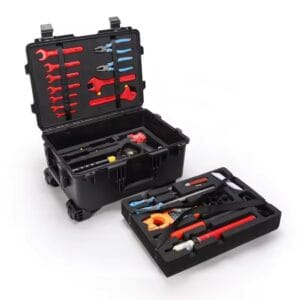
For orthopedic or cardiac surgery kits, organization is as important as protection. We use CNC routing to create multi-level inserts:
- Tiered Access: Place heavy power tools at the bottom and delicate catheters or stents on a top-layer tray.
- Friction-Fit Cavities: No straps or Velcro needed. The foam’s natural elasticity holds the tool securely, allowing the surgeon to “snap” it out instantly.
The ROI of Medical Grade
While XLPE carries a higher upfront cost than commodity foams, the Return on Investment is found in the elimination of “hidden” costs:
- Reduced Contamination Risk: Lowering the chance of a batch being rejected due to foam dust.
- Extended Lifespan: XLPE does not “set” (permanently compress) like cheaper foams, meaning the packaging lasts as long as the device itself.
- Sterilization Compatibility: Compatible with Gamma, EtO (Ethylene Oxide), and E-beam sterilization processes without losing structural integrity.
Whether you are shipping life-saving diagnostic equipment or setting up a long-term laboratory storage system, your choice of foam is your first line of defense against contamination and mechanical failure.