
What is the best foam for heavy equipment?
The best foam for heavy equipment is High-Density Polyethylene (PE), specifically in densities ranging from 2.2 lb/ft³ to 9 lb/ft³. For heavy loads, PE provides the necessary structural integrity to prevent “bottoming out” while offering superior vibration dampening. For sensitive finishes on heavy parts, Cross-Linked Polyethylene (XLPE) is preferred due to its non-abrasive surface and chemical resistance.
Shipping heavy machinery is a battle against gravity and inertia. Unlike lightweight electronics, heavy equipment generates massive kinetic energy during transit. If your foam is too soft, the equipment “bottoms out” against the outer crate. If it’s too hard, it transfers every vibration directly to the delicate internal components.
To find the “Goldilocks zone” of protection, you need to understand the intersection of material science and mechanical engineering.
1. The Physics of Heavy Loads: Understanding Static Stress
Selecting foam for a 5lb laptop is easy. Selecting foam for a 500lb engine block requires math. The most critical metric in heavy equipment packaging is Static Stress.
Static Stress is the amount of pressure the equipment exerts on the foam while sitting still. It is calculated as:
Static Stress (PSI) = Weight of the equipment (lbs) / Total surface area of the foam contact points (sq. in)
For heavy equipment, you must ensure the static stress falls within the “Cushion Curve” of the chosen foam. If the pressure exceeds the foam’s limit, the cells will collapse permanently (a state known as “taking a set”), leaving your equipment rattling loose inside the crate.
2. Comparing the Top 3 “Heavy-Duty” Materials
Not all polymers are built for the weight. Here is how the three industry leaders stack up when the pressure is on.
Material | Density Range | Best For… | Key Weakness |
Polyethylene (PE) | 1.7 – 9.0 lb | The Industry Standard. Heavy pumps, motors, and steel parts. | Can be slightly abrasive on highly polished surfaces. |
Cross-Linked PE (XLPE) | 2.0 – 6.0 lb | High-Value/Medical. Lab equipment, aerospace sensors, lasers. | Higher cost per cubic foot than standard PE. |
Ethylene-Vinyl Acetate (EVA) | 2.0 – 15.0 lb | Reusable Tooling. 5S shadow boards and luxury equipment. | Heavy; adds significant weight to shipping costs. |
Why Polyethylene (PE) Wins for Heavy Machinery
Standard PE is a “closed-cell” foam. Imagine millions of tiny balloons glued together. When a heavy motor is dropped, each “balloon” compresses and then pushes back. This provides a high energy-return rate. Unlike open-cell foam (like your couch cushion), PE will not soak up water or oil, which is vital for industrial parts that may leak residual fluids.
3. Engineering the “Cradle”: Design Strategies
With heavy equipment, you don’t just “box it.” You engineer a cradle. There are three primary design strategies:
The “Floating” Base
For equipment with a heavy bottom (like a generator), a solid block of 4lb-6lb PE foam acts as a shock absorber. The base should be CNC-routed to the exact footprint of the machine to prevent lateral shifting.
Corner Blocking
You don’t always need to fill the entire box with foam. For massive crates, “Corner Blocks” of high-density PE provide 8-point protection. This reduces material costs while focusing the protection on the points of highest impact.
Encapsulation
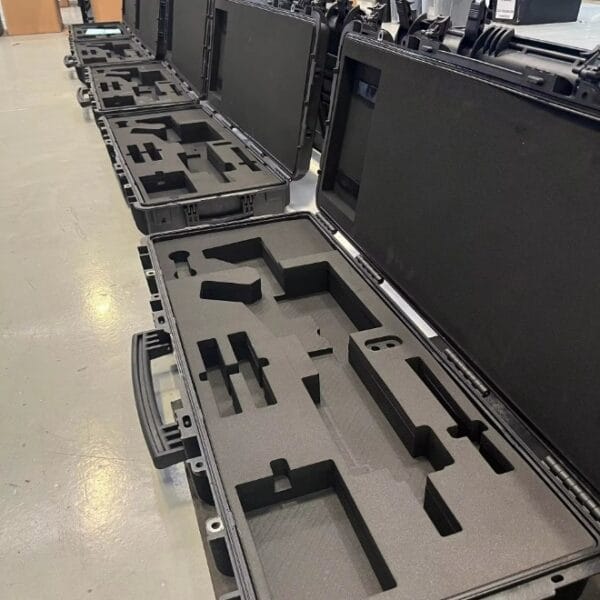
For irregular shapes (like a robotic arm), the equipment is “sandwiched” between two CNC-machined halves. This ensures that no matter which way the crate is tilted, the weight is evenly distributed across the foam surface.
4. Environmental Resistance: The Overlooked Factor
Heavy equipment often sits in “Pre-staging” areas damp warehouses, shipping docks, or in the hold of a ship.
- Moisture: Open-cell foams act like sponges, holding moisture against metal and causing rust. Foamkart’s PE and XLPE are hydrophobic, meaning they repel water entirely.
- Chemical Exposure: Industrial parts often have trace amounts of grease, hydraulic fluid, or solvents. XLPE is chemically inert, meaning it won’t melt or degrade when it comes into contact with petroleum-based products.
5. How to Select Your Foam: A Step-by-Step Protocol
1. Identify the Fragility (G-Factor): How much shock can it take?.
Every piece of equipment has a “G-rating.” A heavy cast-iron pump might survive 100 Gs, while a calibration laser might break at 15 Gs. The lower the G-factor, the thicker and more sophisticated your foam system must be.
2. Calculate the Static Load: Weight vs. Surface Area.
Determine where the equipment’s weight will rest. Use the S = W/A formula. If the PSI is too high for 2.2lb foam, upgrade to 4lb or 6lb density to prevent the foam from “bottoming out.”
3. Determine the Drop Height: Standard shipping risks.
Will this be handled by a forklift (lower drop risk) or a manual courier (higher drop risk)? Standard engineering assumes a 30-inch drop.
4. Select the Material Density: PE vs. XLPE.
Choose PE for raw industrial strength or XLPE if the equipment has a Class-A polished finish that cannot be scratched.
6. The ROI of Engineered Foam for Heavy Equipment
Many procurement departments look at the cost of foam as a “shipping expense.” It is actually a Risk Mitigation Investment.
- Elimination of Freight Claims: A single damage claim for a piece of heavy machinery can cost 10x the price of the packaging.
- Reduced Crate Size: Because high-density PE is so efficient at absorbing shock, you can often use thinner foam than you would with cheap materials, allowing for a smaller, lighter shipping crate.
- Customer Trust: When a client unboxes a $50,000 machine and sees it perfectly cradled in custom-branded foam, it reinforces your brand’s commitment to quality.
Conclusion: Don’t Leave Protection to Chance
Selecting the right foam for heavy equipment requires a move away from “fillers” and toward “engineering.” By matching your equipment’s G-factor with the correct density of Polyethylene, you transform your packaging into a high-performance shock-absorption system.
At Foamkart, we specialize in CNC-precision routing for the heaviest industrial applications. Our team doesn’t just sell foam; we solve the physics of your logistics.