
Choosing the right foam fabrication methods isn’t just a technicality; it’s a financial strategy. If you pick CNC for a 100,000-unit run, you’re hemorrhaging money. If you pick Die Cutting for a complex 3D medical insert, you’re compromising on precision.
At Foamkart, we don’t just “cut foam.” We engineer protection. To do that, we use the big three of fabrication. Here is how they stack up.
The “Gap” Analysis: What Other Blogs Missed
We reviewed the top industry guides on foam fabrication. Here is what they usually overlook and what we are fixing today:
- The “Draft Angle” Myth: Most blogs claim Waterjet is “perfectly precise.” They forget to mention that at depths over 4 inches, the water stream can “lag,” creating a slight taper (draft angle) that affects snug-fit packaging.
- The Tooling ROI: They say Die Cutting is “expensive.” We provide the math: At what exact unit count does a 500 steel-rule die pay for itself compared to “free” CNC programming?
- Variable Depths: Almost no one highlights that CNC is the only method capable of “blind holes” (cavities that don’t go all the way through the foam) in a single solid block.
1. CNC Routing: The Surgeon’s Scalpel
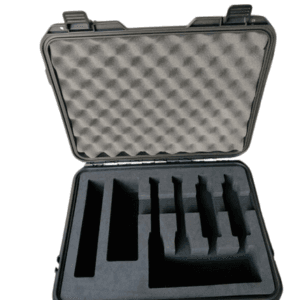
CNC (Computer Numerical Control) uses a high-speed rotating bit to carve shapes out of foam. At Foamkart, we use this for our Custom Case Inserts.
- Best For: Prototyping, low-to-medium volumes, and multi-level designs.
- The Big Win: No tooling costs. You send us a CAD file, and we start cutting. It’s the only way to get multiple “steps” or “depths” in a single piece of XLPE foam.
- The Limitation: It’s slower. Because the bit has to travel the entire perimeter and “hog out” the cavities, the unit price stays higher as volumes increase.
2. Die Cutting: The High-Speed Press
Imagine a giant, incredibly sharp cookie cutter. That’s Die Cutting. A steel-rule die is built to your specs and pressed through the foam in a single strike.
- Best For: High-volume production (1,000+ units) and simple 2D shapes.
- The Big Win: Speed. Once the die is made, we can pop out hundreds of EPE foam fitments per hour.
- The Limitation: “Die Crush.” For very thick or very soft foams, the pressure of the die can slightly deform the edges. It also requires an upfront investment in the tooling (the die itself).
3. Waterjet Cutting: The Cold Power
A needle-thin stream of water pressurized at 60,000 PSI slices through foam like butter.
- Best For: Thick, dense foams (up to 8 inches) and heat-sensitive materials.
- The Big Win: Zero heat-affected zones. Since it’s a “cold” cut, there’s no melting or singeing on the edges perfect for Medical Equipment Foam.
- The Limitation: It cannot do “blind” depths. A waterjet cuts all the way through. If you need a pocket that is only 1 inch deep in a 2-inch block, you have to cut the pocket and then “laminate” (glue) it to a base layer.
Technical Comparison: Fabrication at a Glance
| Feature | CNC Routing | Die Cutting | Waterjet Cutting |
|---|---|---|---|
| Tooling Cost | 0rs | High | 0rs |
| Variable Depth? | Yes | No | No |
| Edge Finish | Good (Minor bit marks) | Clean (But may "crush") | Extremely Clean |
| Lead Time | Short (Hours) | Long (Days for Tooling) | Short (Hours) |
| Ideal Quantity | 1 – 500 units | 1,000+ units | 1 – 1,000 units |
QNA
Q: Which foam cutting method is cheapest?
For small batches (under 100), CNC or Waterjet are cheapest because they have zero tooling costs. For mass production (1,000+), Die Cutting is the cheapest due to its rapid cycle time per unit.
Q: Can you cut 3D shapes in foam?
Yes, but only with CNC Routing. Die cutting and Waterjet are limited to 2D profiles that go through the entire thickness of the material (unless parts are later laminated).
Q: What is the most precise way to cut thick foam?
Waterjet cutting is the most precise method for thick foam (up to 10 inches), as it eliminates the “bit deflection” found in CNC and the “edge crush” found in Die Cutting.
Why Foamkart?
At Foamkart, located in the heart of Bangalore, we don’t just give you a quote; we give you a consultation. We look at your material whether it’s EVA, XLPE, or PU and your volume to recommend the fabrication method that maximizes protection while minimizing cost.
Need a precision fit for your hardware?
Contact Foamkart today for a custom CAD layout and a fabrication strategy that works as hard as you do.