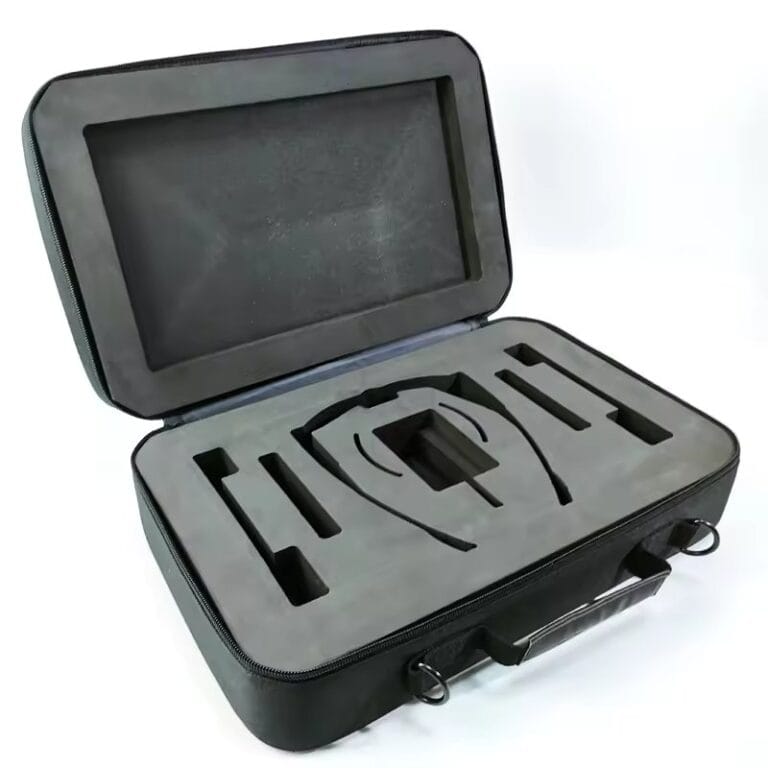

In the medical field, “good enough” is a dangerous phrase. When you are transporting a $100,000 portable ultrasound or a delicate surgical laser, the packaging isn’t just a box—it’s a life-support system for the technology itself.
If you are looking for the right foam for medical equipment, you aren’t just looking for a cushion. You’re looking for a material that won’t off-gas, won’t degrade under hospital-grade disinfectants, and won’t interfere with sensitive calibration.
The “Gap” Analysis: What Other Medical Blogs Miss
We analyzed the top three global leaders in medical foam blogging. While they cover the basics, they almost always leave out three critical factors that matter to engineers and hospital administrators:
- The “Shedding” Problem: Most blogs talk about “softness,” but they ignore particulate shedding. In a cleanroom or surgical suite, a single microscopic foam flake can ruin a sterile environment.
- Chemical Resilience: They say foam is “washable.” We go deeper: How does it stand up to Isopropyl Alcohol (70%) or Bleach-based wipes over 500 cycles?
- The Ergonomic Speed-Dial: Most packaging blogs focus on shipping. In medical, we focus on access. If a surgeon can’t grab a tool in two seconds because the foam is too tight, the packaging has failed.
What Actually Makes Foam “Medical Grade”?
To truly protect medical equipment, the material must meet specific purity and safety standards. At , we prioritize Nitrogen-Expanded Cross-Linked Polyethylene (XLPE).
1. Purity and Off-Gassing
Standard foams use chemical blowing agents that can leave “residue” or “smell.” For medical applications, we use nitrogen-blown foams. Because nitrogen is an inert gas, there are no chemical leftovers to leach onto your equipment’s sensors or lenses.
2. Biocompatibility (ISO 10993)
If the foam touches skin (like in a patient positioner or a wearable device), it must be ISO 10993 compliant. This ensures it is non-cytotoxic, non-irritating, and non-sensitizing.
3. Radiolucency
Modern medical diagnostics often require equipment to stay in its “cradle” during testing. Our use radiolucent materials that won’t cause “artifacts” (ghost images) on X-rays or CT scans.
Comparison: Medical Foam Performance Metrics
The Engineer’s Checklist: Foam for Medical Equipment
When designing your next with Foamkart, ask these three questions:
Q: Is the equipment “Calibration Sensitive”?
If your device has a gyro or sensitive internal optics, you need a specific Static Stiffness to ensure the foam doesn’t “creep” over time. If the foam loses its shape by even 1mm, your device could lose its calibration.
Q: Will it be used in an EMS/Ambulance environment?
For mobile medical gear, you need high-density . It acts as a shock absorber for the high-frequency vibrations of a moving vehicle, preventing “vibration fatigue” in electronic solder joints.
Q: Does the layout follow “Visual Management”?
We use Dual-Color Foam Inserts (e.g., a black top layer with a red base). This allows a clinician to see at a glance if a piece of equipment is missing. If you see red, a tool is gone. This “shadow-boxing” technique saves lives in fast-paced ER environments.
QNA
Q: What is the best foam for medical equipment packaging?
The best material is typically Cross-Linked Polyethylene (XLPE) or Nitrogen-Expanded foam. These materials are closed-cell, non-absorbent, and do not off-gas, making them safe for sensitive electronic sensors and sterile environments.
Q: Is polyurethane foam safe for medical devices?
Polyurethane (open-cell) is excellent for light cushioning and disposables but should be used with caution for long-term storage, as it can absorb moisture and harbor microbial growth unless treated with antimicrobial additives.
Q: Can medical foam be sterilized?
Yes, specific closed-cell foams like Plastazote or high-density XLPE can be cleaned with hospital-grade disinfectants and, in some cases, autoclaved or sterilized via Gamma radiation without losing structural integrity.
The Foamkart Promise: Precision Where it Matters
We don’t just cut foam; we engineer protection. Whether you are shipping a fleet of ventilators or a single prototype robotic arm, our are designed to exceed ISO standards and survive the rigors of the modern healthcare “battlefield.”
Ready to secure your medical innovation? to find the exact density and purity for your application.